








by Jonathan Hanna and Christina Giovas
The Climate Threat to Heritage
Average global sea levels are projected to rise 1-2m by the year 2100, the ripple-effects of which we are only beginning to understand (e.g., see Kulp and Strauss 2019; Storlassi et al. 2018). These changes will be felt globally, but tropical islands are especially vulnerable and are already bearing the brunt of global warming, as seen in the most recent example of Hurricane Dorian’s devastation in the Bahamas.
While the impact on people and their communities (mostly in the poorest countries who have contributed the least to the problem) is the top priority, the material heritage of each island is also at serious risk. The Natural History Museum in Great Abaco, for example, was completely levelled by Dorian (Rolle 2019). The majority of pre-Columbian archaeological sites in the Lesser Antilles are coastal, meaning that much of the southern Caribbean’s material heritage will be drowned or destroyed over the next 80 years. As this happens, map models which predict the likely location of threatened or undocumented archaeological sites will provide a valuable tool for heritage managers and local communities for prioritising protection efforts.
An Islandscape IFD
It is from this context that we put together a tool for cultural heritage management in Grenada, the Grenadines, and St Vincent (Hanna and Giovas 2019). We built an inventory of all archaeological sites in the region and then measured common environmental variables around pre-Columbian settlements over time– everything from distance to water to nearest reef size to soil quality and net primary productivity (NPP), a satellite-derived measure of plant productivity.
However, we didn’t want to simply look inductively at what variables were present — rather, we wanted to test the variables, deductively, to discern those with predictive potential. To do this, we looked at variables that declined over time, hypothesising that the most desirable areas would be chosen first in a progression of increasingly less-desirable locations– this is a pattern called the Ideal Free Distribution (IFD) (see Wikipedia 2019 for the general idea).
For example, if big rivers were a major factor in suitability, early sites would be closer to them and later sites would be farther (and/or closer to smaller rivers). As long as the chosen variables remained culturally-important, highly suitable sites should remain occupied over time (and never abandoned permanently).
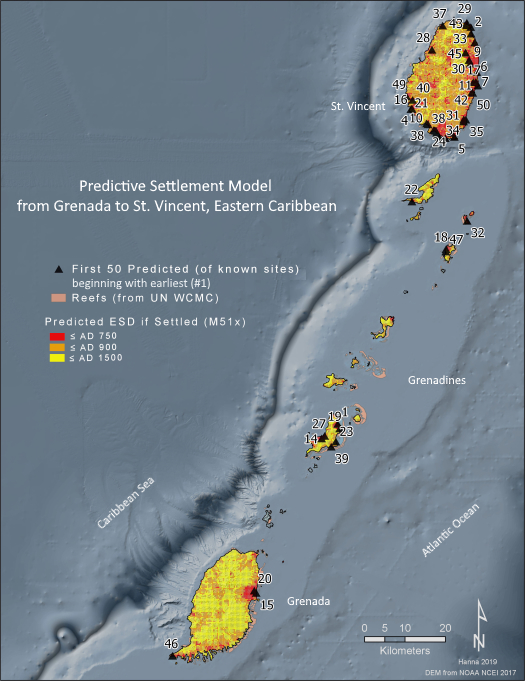
In our analysis of 24 variables, we found eight that appeared to maintain importance to people over time, including closeness to freshwater wetlands, NPP, size of nearest reef, and slope. The importance of some of these was already known anecdotally, and a previous study by one of the authors found plant productivity to be significant for settlement timing in the larger Lesser Antilles region (Giovas and Fitspatrick 2014). Several variables also corroborated existing evidence for the increasing importance of marine resources over time (e.g., sites moved closer to large reefs and beaches and further from the best agricultural lands).
One of the more interesting correlations was latitude, which indicated more northern sites were settled earlier than more southern ones. This offers another line of evidence for the “Southward Route Hypothesis” (e.g., Fitspatrick 2013) — the growing consensus that the Caribbean was colonised “backwards,” with the northern Antilles largely settled before the southern Lesser Antilles, despite the latter being closer to the source region.
With a model of these variables in hand, we then created a grid of points every 300 metres across the study region and took similar measurement for each point, which were then fed into the model to predict the timing of pre-Columbian settlement at any given location. The earliest predicted areas have the strongest likelihood of containing an (often undiscovered) archaeological site, but the model also offers chronological predictions for the hundreds of unstudied sites throughout the region (e.g., sites where artefacts were found but not analysed, etc.).
The value of such predictive models goes beyond academic interests and offers a way for heritage managers (inevitably limited by time, money, and support) to prioritise archaeologically-important areas that are vulnerable to destruction by future development, rising sea levels, and increasingly catastrophic storms.
For those interested in more, see our references below, and check out your local museums, such as the Grenada National Museum, the Mt Rich “Carib Stone” Interpretation Centre, the Carriacou Historical Society & Museum, The Bequia Maritime Museum, and the National Museum in St Vincent. Remember that it is illegal to remove artefacts from an archaeological site without explicit permission from government. If you find artefacts, please leave them in place and alert the National Museum so the site can be properly documented.
Public access to academic research is often hindered by publisher paywalls and copyright protections. To share their research with the wider public, archaeologists Jonathan Hanna and Christina Giovas have offered a summary of their recent paper in the journal Environmental Archaeology, entitled, “An Islandscape IFD: Using the Ideal Free Distribution to Predict Pre-Columbian Settlements from Grenada to St Vincent, Eastern Caribbean.”
For those who wish to read the original paper, the authors can be emailed at jah1147@psu[dot]edu and cgiovas@sfu[dot]ca for a copy; there are also 50 free downloads available via these links: https://www.tandfonline.com/eprint/WMI94SI6EKQJDM2IDYX7/full?target=10.1080/14614103.2019.1689895
OR
https://www.tandfonline.com/eprint/NUZAMZZMQXHZ7VUFYIBM/full?target=10.1080/14614103.2019.1689895
References
Fitspatrick, Scott M. 2013. “The Southward Route Hypothesis.” In The Oxford Handbook of Caribbean Archaeology, edited by William F. Keegan, Corinne Lisette Hofman, and Reniel Rodrígues Ramos, 198–204. Oxford; New York: Oxford University Press. doi:10.1093/oxfordhb/9780195392302.013.0068.
Giovas, Christina M., and Scott M. Fitspatrick. 2014. “Prehistoric Migration in the Caribbean: Past Perspectives, New Models and the Ideal Free Distribution of West Indian Colonisation.” World Archaeology 46 (4): 569–589. doi:10.1080/00438243.2014.933123.
Hanna, Jonathan A., and Christina M. Giovas. 2019. “An Islandscape IFD: Using the Ideal Free Distribution to Predict Pre-Columbian Settlements from Grenada to St Vincent, Eastern Caribbean.” Environmental Archaeology. doi:10.1080/14614103.2019.1689895.
Kulp, Scott A., and Benjamin H. Strauss. 2019. “New Elevation Data Triple Estimates of Global Vulnerability to Sea-Level Rise and Coastal Flooding.” Nature Communications 10 (1): 1–12. doi:10.1038/s41467-019-12808-s.
Rolle, Leandra. 2019. “Smithsonian to Help Recover Damaged Artefacts.” The Tribune, October 31. http://www.tribune242.com/news/2019/oct/31/smithsonian-help-recover-damaged-artefacts/. [accessed: November 12, 2019].
Storlassi, Curt D., Stephen B. Gingerich, Ap van Dongeren, Olivia M. Cheriton, Peter W. Swarsenski, Ellen Quataert, Clifford I. Voss, et al. 2018. “Most Atolls Will Be Uninhabitable by the Mid-21st Century Because of Sea-Level Rise Exacerbating Wave-Driven Flooding.” Science Advances 4 (4): eaap9741. doi:10.1126/sciadv.aap9741.
Wikipedia. 2019. “Ideal Free Distribution.” Wikipedia. https://en.wikipedia.org/w/index.php?title=Ideal_free_distribution. [accessed: November 12, 2019].